Make a Payment
 Purchase a License
Every school’s usage report reflects the many ways music connects students, families, educators, and communities throughout the academic year. Behind each of those moments are the composers, songwriters, arrangers, artists, publishers, and record labels whose work helps bring those experiences to life.
When a school submits a report through School Music License, it documents those memorable experiences and creates a record of how music was used and shared online.
What actually happens after you click Report?
Step 1: Your Event Becomes Part of the Record
A report captures information about the music used during a streamed school event or performance: titles, composers, arrangers, songwriters, labels, and publishers.
Whether events are broken down by week or through an organized repertoire list using our “List” feature, this record allows you and your team to reference reported works over the course of the school year. Historical records can be accessed year after year, documenting your repertoire long after the school year ends.
Step 2: The Information Is Processed
Once submitted, reporting data is reviewed and organized before being shared with the appropriate rights holders and industry partners.
At School Music License, this process involves collaboration with our colleagues at Music Reports who specialize in music rights administration. While every publisher and label has its own processes, accurate reporting helps ensure music usage information can be prepared and delivered for the royalty distribution process.
Step 3: Music Usage Becomes Visible
Reporting provides visibility into how music is being used across K-12 schools. At School Music License, we support musical works that are distributed online to families and communities via streaming and posting on the major social media platforms: YouTube, Facebook, Instagram, Snapchat, and TikTok. This visibility helps ensure school performances and events are reflected within the broader music ecosystem.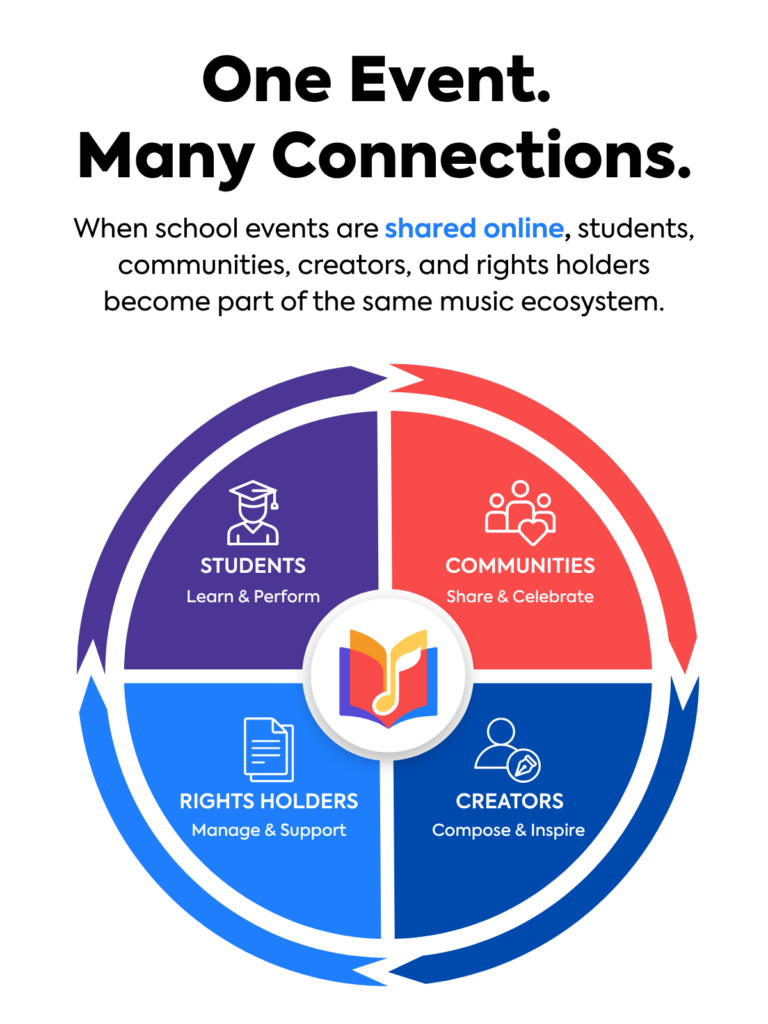
Why It Matters
The National Endowment for the Arts describes the arts as a “great connector,” linking people to their communities through shared experiences. Recent research shows that arts participants are nearly four times more likely to be civically and community engaged than non-arts participants. School performances and events help create those connections at the local level, bringing together students, families, and communities through shared musical experiences.
As schools increasingly share those experiences online, they become part of a broader network of music usage and engagement. Reporting helps ensure educational performances and events are represented within the systems that support music licensing, creator recognition, and royalty distribution. In that way, reporting helps maintain the information needed for those processes to function effectively.
When music is used online, accurate usage data helps connect that use back to the people who created it.
K-12 Schools, Online Sharing, and The Bigger Picture
For students, music often represents some of the most memorable moments of their school experience. A graduation processional, a marching band performance under the Friday night lights, a senior night choir concert, or a championship game become indelibly woven into the fabric of our local communities.
Reporting is one of the most tangible and practical ways that K-12 schools and school districts can participate responsibly in online sharing.
In that way, a usage report is more than a form to be completed quarterly. It is part of the ever-evolving relationship between K-12 education and the music community: one that helps ensure the people who create music remain connected to the many ways their work inspires audiences across the country.
The School Music License platform offers a wide variety of tools to help you succeed in your usage reporting. From duplicating reports for music used weekly to offering a quarterly window to plan ahead or catch up, educators are empowered to be successful throughout the entire school year. Lingering questions? Contact our team at info@schoolmusiclicense.com.
Photo used with permission from Canva.com